STADTFORUM DRESDEN
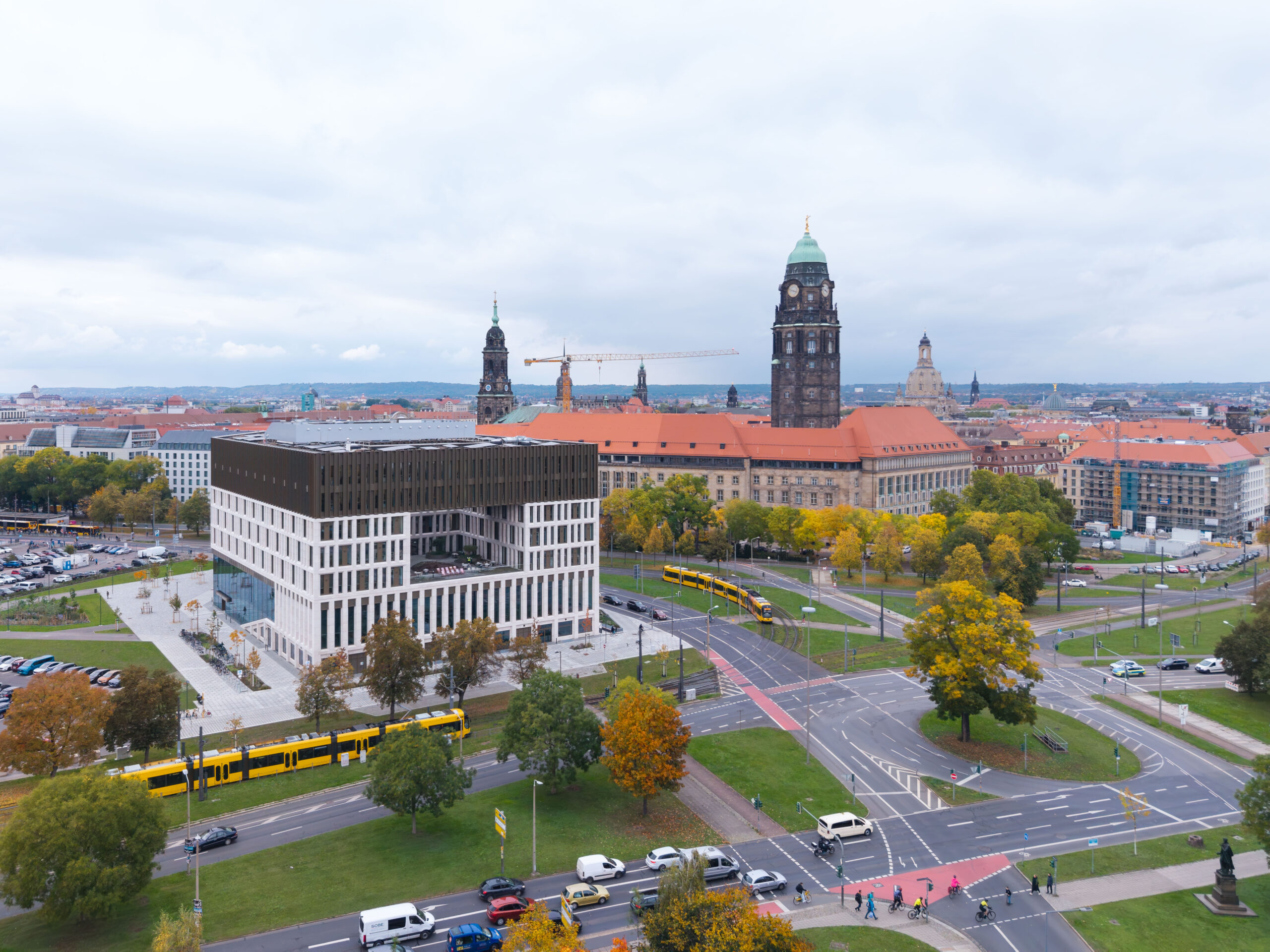
As part of the wider redevelopment of Ferdinandplatz, the new Verwaltungszentrum (city headquarters) will play a key role in reshaping Dresden’s civic core. Designed by Barcode Architects and Tchoban Voss Architekten, the 34,000 m² building occupies a central inner-city site and brings together public services in a single, open, and accessible volume.
The design is all-sided and carefully positioned within its urban context. Three large-scale openings are carved from the building’s mass: a window to Ferdinandplatz creates a strong connection with the public square, another frames a view to the historic Rathaus, and a raised green patio opens toward the Großer Garten. Together, these urban ‘windows’ strengthen the building’s relationship with its surroundings and introduce daylight deep into the interior.
Location
Dresden, Germany
Client
Züblin / Strabag, Dressler Bau
Year
2019 – 2025
Status
Completed
Size
34.000m²
Category
Public building
Collaborators
Tchoban Voss Architekten (partner architect), Züblin AG (main contractor), Züblin AG (TBK) Stuttgart (structural engineering), Werner Genest und Partner Ingenieurgesellschaft mbH (building physics, acoustics), Prof. Rühle, Jentzsch und Partner GmbH (fire safety), ZB Zimmermann und Becker GmbH (installations), Noack Landschaftsarchitekten (landscape design)
Team


Dirk Peters, Robbert Peters, Leon Seibert, Agata Majcherska, Jelena Nikolic, Martina Cicolari, Michele Cherubini, Hamed Jahanbanzejad, Maurits Verhoeff, Julia Hejmanowska, Luca Braccini, Alizee Taimanglo, Giacomo Reguzzi, Stefan Hutterer, Lea Hofmann, Ruggero Pedrini, Beatrice Piola


Visitors enter from Ferdinandplatz into a welcoming city foyer. This open ground floor space includes the main reception, public service counters, a restaurant, and meeting areas. On either side of the entrance, broad staircases lead up to the first floor. One of these functions as an ‘agora’—a stepped auditorium that doubles as a stage for presentations or public debates. The upper level houses a conference centre and acts as a shared living space for civil servants and citizens, with panoramic views of the city.


Office spaces are organised around two green courtyards, which serve as the building’s lungs. These patios offer natural daylight, orientation, and visual calm throughout the work environment. The eastern garden is lifted above street level to create a semi-public terrace overlooking St. Petersburgerstrasse—an informal outdoor space for meetings or breaks.

The building’s three-part façade reflects Dresden’s architectural character while introducing a clear human scale. Natural stone cladding anchors the project in its historic context and mediates between the old city and the city’s contemporary ambitions. Floor-to-ceiling windows open the warm wooden interiors and planted walls to the public realm. A darker upper crown subtly reduces the perceived height and gives the volume a defined, calm finish. The result is a building that sits confidently in its surroundings and contributes to a transparent, welcoming civic environment.


Dirk Peters, founder
We are particularly proud to present our winning design for the Dresden City Headquarters. In addition to our ongoing German projects, this is our first major public project in the Saxony region.
It is a design with a special identity that strengthens our focus and future role in Germany. The cooperation with Tchoban Voss Architekten, who are based in Dresden, is natural and shows that the combination of international design and German expertise can lead to a strong and impressive result.


