Thornico Village
Rotterdam is a city that continues to grow in both population and ambition, but space within the urban core is increasingly scarce. Much of the inner city was rebuilt after the war and has since gone through successive waves of renewal. As demand rises for new housing and workspaces, the question is shifting from where to build to how to reuse the structures that are already in place.
Location
Rotterdam, The Netherlands
Client
Thornico Group, SENS Real Estate
Year
2025
Category
Feasibility Study
Team


Dirk Peters, Ronald Hoogeveen, Mirco Facchinelli, Laetitia Devi Augustyniak, Alessandro di Santo.
Visualisation: Ruggero Pedrini, Ali Ansari Shahri


Among the most overlooked opportunities are the city’s rooftops. They stretch across thousands of square meters, yet most remain restricted to technical equipment and maintenance access. In recent years, small experiments with green roofs and cultural programs have started to reveal their potential. Thornico Village builds on this momentum by exploring how a rooftop can become more than a surface, how it might host a living, breathing community above the city.


The study is set on top of an existing parking structure in central Rotterdam. From the outset, the ambition was to design something modular, flexible, and green. Lightweight prefabricated wooden units were proposed to minimize structural impact while allowing the program to evolve over time. What begins as one configuration could transform into live–work spaces, offices, or other uses that respond to the shifting needs of the city.
Two practical challenges shaped the design. The first was access. A long open-air stair and a lift connect the rooftop village and parking deck directly to the street below, ensuring that the project is not an isolated platform but an accessible extension of the city. The second was buildability. Existing structural reinforcements were used wherever possible, with new supports added only where required. This led to a modular system that can be built in phases and organized into distinct zones.

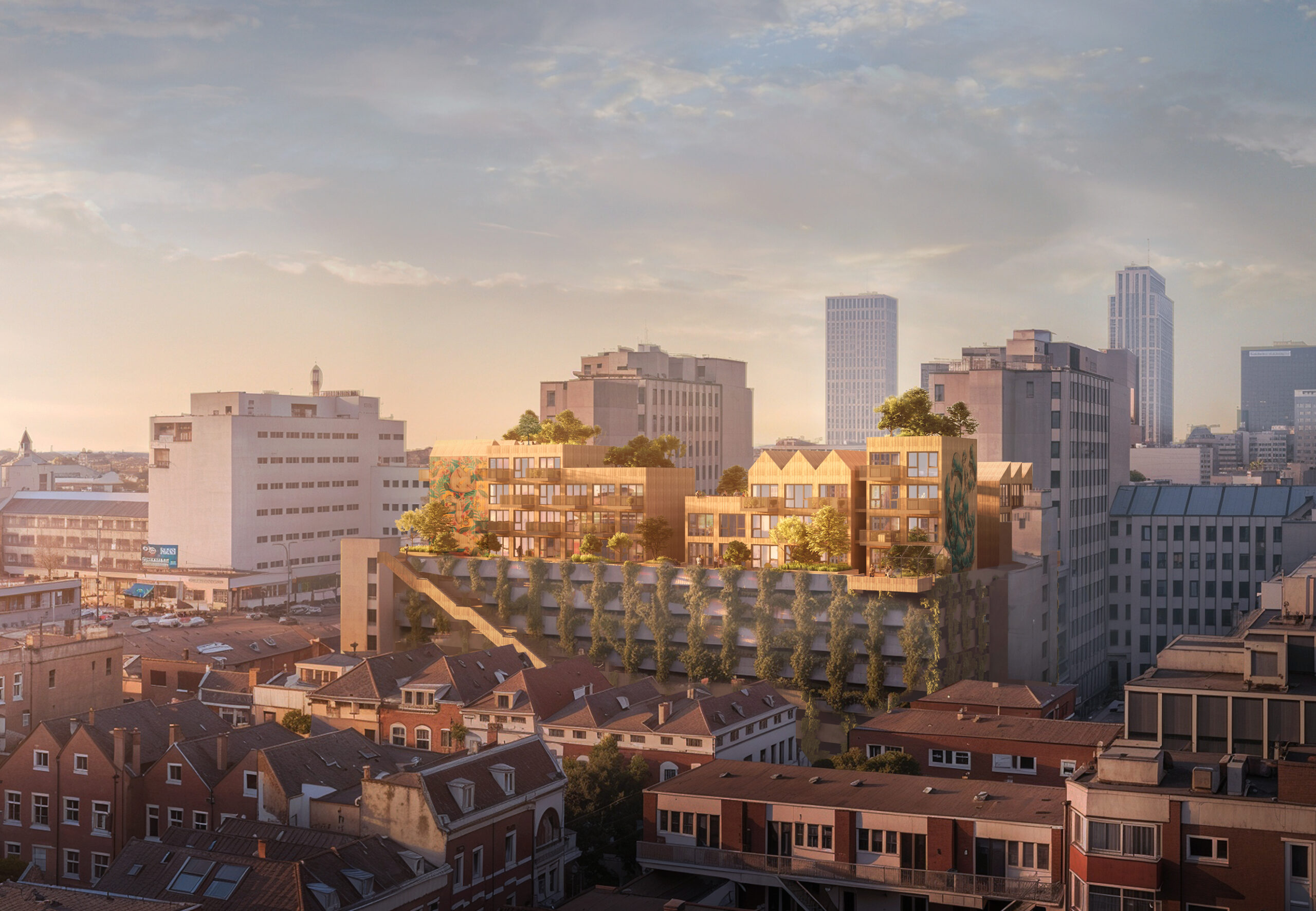
Within this framework, the project creates a balance of collective and private spaces while maintaining a physical and visual connection to the adjacent office building. A large terrace opens toward Rotterdam’s skyline, offering expansive views and a sense of connection to the city. In contrast, a sheltered courtyard provides a more intimate communal space for occupants. Together, these spaces suggest how a rooftop can foster both public presence and private retreat.
Thornico Village tests how the function of an existing building can be extended by turning its rooftop into a site of collective life. In doing so, it points to a future where rooftops play an active role in the city’s regeneration, offering room for growth without consuming more land.